
EV charger installation in Lockport, IL
A Level 2 charger in your garage on its own 240-volt circuit, in conduit, permitted and inspected. The electrician checks the panel before quoting, because on the east-side two-stories the panel is usually the question.
Every electrician we send to a Lockport address holds a license from an Illinois licensing-and-testing community, is registered with the City of Lockport Building Department, and carries the City's required bond and liability coverage. Permits are pulled for the work that needs them.
Get a charger estimate
Say which car, whether the panel is in the garage or the basement, and how far the charger is from it. The electrician calls back with a price and a date.
Prefer the phone? (815) 524-0195. Say what tripped, what you want added, or what the inspector wrote up.
What a home charger install involves here
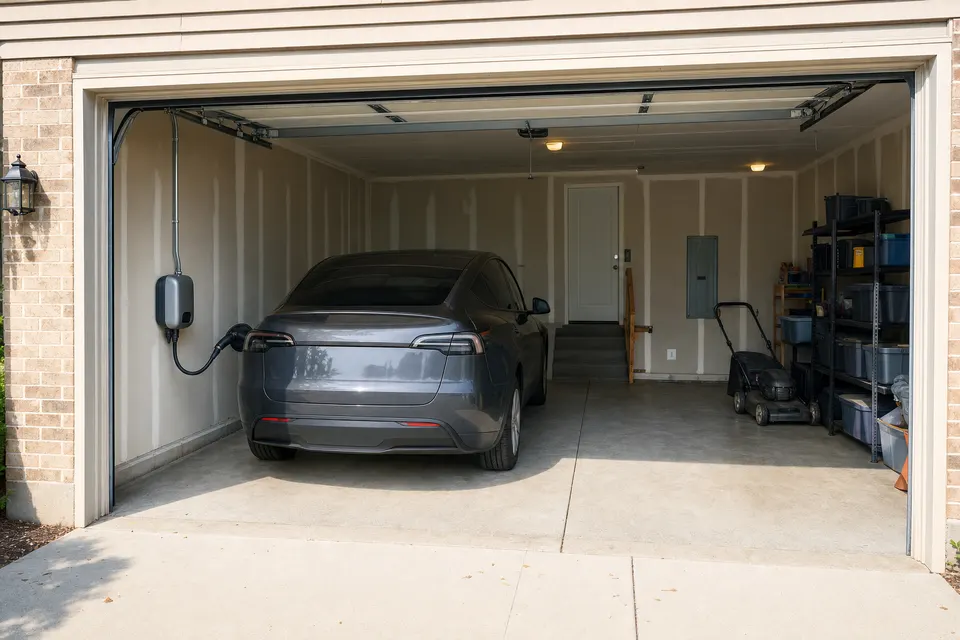
A Level 2 charger draws 32 to 48 amps for hours at a time, so it gets a dedicated circuit from the panel: a two-pole breaker, conduit to the garage wall, and either a hardwired unit or a NEMA 14-50 receptacle. Lockport requires a permit for the new circuit and a final inspection. Two things set the price.
Where the panel is
Panel in the garage, charger on the next wall: a short conduit run and a half-day job, $650 to $1,400. Panel in the basement on the far side of the house, or a detached garage across the yard: a long run through the joists or a trench, $1,200 to $2,200.
Whether the panel has room
A 200-amp panel with two open slots takes a charger without a second thought. A 100-amp service on a ranch, or a 150-amp panel packed full on a two-story, needs a load calculation first. The honest outcomes are a charger that shares load with the dryer, a subpanel, or a panel upgrade done at the same time. The load math is on the help page.
Not the chargers at City Hall
Searching "EV charger Lockport" turns up the public stations downtown and at the car dealers on Route 7. This page is about the one in your garage. If you charge at home you will use the public ones a few times a year; the home circuit is what makes the car cheap to run.
Which charger
The electricians we work with install whatever unit you buy, as long as it is listed and rated for the circuit. A 40-amp plug-in unit on a 14-50 is the common choice; 48-amp hardwired for the trucks and the two-car households. Tesla, Ford, Hyundai and the universal units all wire the same way. What matters more than the brand is the breaker size, the conduit and the GFCI protection.
Adding a generator later? A charger is the load that changes the sizing math. Standby generators covers it.
Charger questions from Lockport
Can I just plug my EV into the dryer outlet?
You can for a while, and plenty of people in the subdivisions do. A dryer receptacle is not GFCI-protected the way a charging circuit has to be, it was not sized for a continuous eight-hour load, and the cord across the garage is the part that fails. A dedicated 240-volt circuit is the fix, and it is the smaller half of most charger jobs.
Does the charger have to be hardwired?
Not always. A NEMA 14-50 receptacle on a 50-amp circuit works for a plug-in charger up to 40 amps and lets you take the unit with you. Hardwired is the choice for a 48-amp charger or a garage where the receptacle would be in the way. Either way the circuit is GFCI-protected and in conduit.
What if the panel is full?
That is the most common answer on the 1990s two-stories: the 150-amp panel is full of finished-basement circuits and there is no 50-amp slot. The options are a load calculation that frees space, a charger with load management that shares a circuit, or a subpanel. The electrician runs the numbers before quoting; the answer is on the panel-upgrade-for-a-charger page.
Is there a rebate?
ComEd has run residential charger rebates under its beneficial-electrification programs, and the terms change year to year. The federal credit for home charging equipment changed in 2026. The electrician checks what is open when the job is quoted; the price stands on its own without it.
How long does the install take?
Two to four hours on a panel with room; a full day with a long run. The charger works the same evening.